

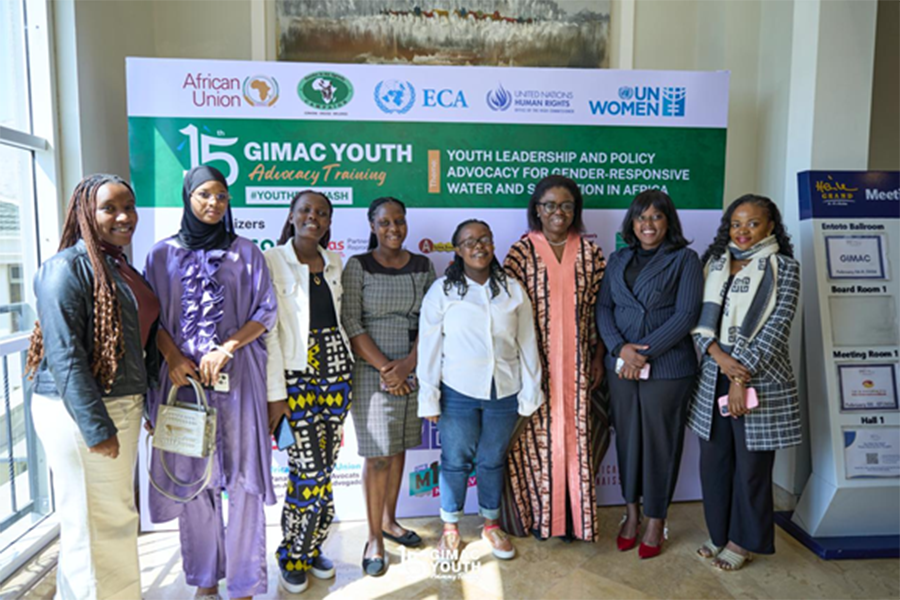
In 2024, while I was a finalist at the Bridge Institute of Information Technology pursuing a National Certificate in ICT, I was selected—together with three other girls—to participate in the African Girls Can Code Initiative (AGCCI) training at Mountains of the Moon University in Fort Portal. The program brought together participants from across the region and lasted two weeks.
It was one of the most transformative experiences of my academic journey. I gained practical skills in website development, robotics, and digital innovation. At the end of the program, we received certificates, but more importantly, UN Women established a HUB in our region. This HUB gave us the opportunity to continue strengthening our skills and extend knowledge to other young people in the community.
In January 2026, I received a life-changing phone call from Madam Joy. She informed me that I had been selected to represent Uganda at the 42nd GIMAC WASH Initiative Youth Advocacy Training in Addis Ababa, Ethiopia, scheduled for 5th to 9th February 2026. The opportunity required participants to be alumni of the AGCCI training, possess a valid passport, and submit documentation such as bank details and a Yellow Fever vaccination card. I was privileged to meet all the requirements, and representing my institution and my country at a continental platform was both humbling and empowering.
Before departure, we joined online briefings with stakeholders to prepare for the training. During the sessions in Addis Ababa, I learned how deeply water access and sanitation are connected to girls’ education. One powerful statement from a keynote speaker continues to resonate with me: “Water needs justice.” When water systems fail, girls are disproportionately affected, often dropping out of school due to lack of access to water and menstrual hygiene products.
I also discovered the importance of evidence-based advocacy. Without statistics, information lacks credibility. Effective advocacy requires data, documentation, and proof. Our discussions went beyond identifying problems—we focused on actionable solutions aligned with Africa’s Agenda 2063 vision.
My Recommendations and Commitments
- Engage stakeholders within our local communities.
- Develop detailed, solution-oriented proposals with clear problem statements and practical interventions.
- Advocate against school dropout among girls.
- Mobilize community support to provide menstrual hygiene materials to vulnerable girls.
- Strengthen social networks to sustain advocacy efforts.
The training was inclusive, bringing together women, men, youth, and girls with disabilities. It amplified diverse voices and emphasized collective responsibility.
Conclusion
The 42nd GIMAC WASH Initiative was one of the most impactful experiences of my life. It strengthened my commitment to advocate for girls’ rights, access to education, and WASH justice across Africa. I am deeply grateful to UN Women for the opportunity, and I pledge to use the knowledge gained to empower more women and girls. I will continue to be a voice for the voiceless as we work towards a better Africa by 2063.


